
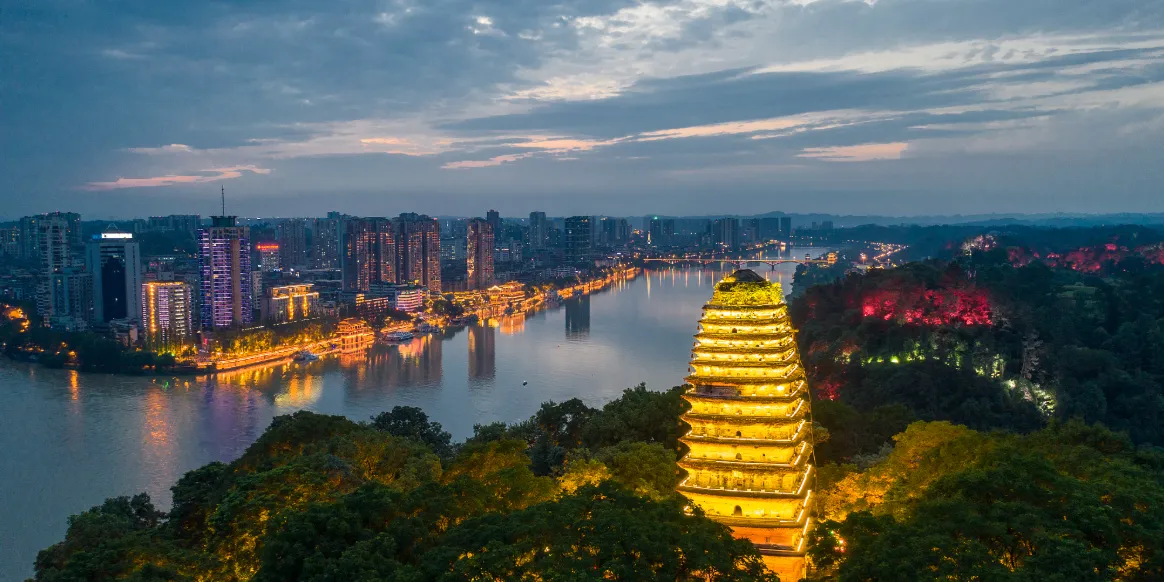
Main attractions in Leshan:
Culture, history, and religion
Leshan Giant Buddha
The world’s tallest stone-carved seated Buddha, standing 71 meters tall, sits facing the river, silently gazing over the confluence of three rivers for more than a thousand years. Starting from Lingyun Temple, follow the Nine-Curve Cliff Path descending along the cliffside to reach the Buddha’s foot platform, where you can look up at the Buddha’s toes meeting the river surface. From a boat on the river, the entire mountain appears like a colossal Buddha lying horizontally in the water—mountain and Buddha merging into one, creating an awe-inspiring spectacle. Early morning brings the fewest visitors, offering the most profound sense of the Buddha awakening; at night, nighttime tours of Lingyun illuminate the Buddha’s silhouette with lights, revealing another magical dimension. Whether or not you believe in Buddhism, standing before the Buddha naturally brings a deep sense of stillness.
Oriental Buddha Land
Adjacent to the Leshan Giant Buddha, this is another realm of Buddhist sanctity. The caves here are carved into the mountain, with reclining Buddhas and sculptural groups layered across the cliffs, unfolding the evolution of Buddhist art through time directly onto the rock walls. Compared to the main Buddha scenic area, this place is quieter and more relaxed—perfect for those who don’t mind taking their time to explore and photograph at leisure.
Wuyou Temple / Wuyou Mountain
Wuyou Mountain, opposite the Giant Buddha across the river, resembles a floating green snail on the water. The riverside path winds through dense woods, and Wuyou Temple lies nestled among the hills, with light incense and sparse visitors. Walking slowly from Lingyun to Wuyou offers a panoramic view of the Three Rivers’ Confluence, with the river breeze brushing your face—a perfect route in Leshan for letting your mind wander freely.
Leshan Confucian Temple & Laoxiao Ding
To discover the authentic essence of old Jiazhou, visit the Confucian Temple and Laoxiao Ding. The red walls and yellow tiles of the temple exude scholarly elegance; Laoxiao Ding, the highest point in the city, reveals the old city ramparts and traditional alleyways beneath your feet. At sunset, climbing to the top bathes the entire riverside city in warm golden light. Take your time, stroll slowly—just like locals enjoying a post-dinner walk.
Nature and famous mountains
Mount Emei
One of China’s four great Buddhist mountains, Mount Emei is the sacred site of Samantabhadra Bodhisattva. The sea of clouds at the Golden Summit is magnificent, with sunlight spilling across the peaks at sunrise; the Liang Pavilion at Wanian Temple and the bronze statue of Samantabhadra embody centuries of devotion. Beneath Qingyin Pavilion, streams flow gently through valleys, and monkeys occasionally appear, adding wild charm. Riding the sightseeing bus and cable car makes reaching the summit easy, while those with stamina may prefer hiking from Bao Guo Temple through Qingyin Pavilion and Wanian Temple—a slow, spiritual pilgrimage. The summit is windy and cold—remember to bring a jacket.
Jinkou Gorge of the Dadu River
Here, the Dadu River cuts deeply through the mountains, forming a profound canyon with sheer cliffs on either side and rushing waters below—the so-called ‘Geological Scripture.’ Driving through the gorge, tunnels and iron-chain bridges alternate, making the car window feel like a screen showing a nature documentary. Ideal for self-driving, photography, and light hiking, the roar of wind and water is powerful, and every shot feels like a wallpaper-worthy masterpiece.
Ancient towns and industrial retro
Suji Ancient Town
A water town with 1,400 years of history, and the birthplace of Qiāojiǎo Beef. Old stone bridges span the stream, stilt houses line the banks, and teahouses and sweet rice cake stalls dot the alleys. Find a family-run shop, sip a steaming bowl of beef bone soup, then sit by the bridge and enjoy a slice of cool rice cake, watching the river flow slowly—time itself seems to slow down.
Luocheng Ancient Town
This hilltop town resembles a massive ship, with its main street shaped like a ‘boat-shaped street,’ earning it the nickname ‘China’s Noah’s Ark.’ Bamboo chairs sit under shaded pavilions, where locals play cards, drink tea, and listen to Sichuan opera drumbeats. Visitors stepping in feel like they’ve entered a living memory of southern Sichuan’s past. No fences, no performances—only genuine local life and bustling street scenes.
Jia Yang Mini Train
This narrow-gauge steam train, originating from the industrial era, chugs through the countryside of Jianwei, belching white smoke. In spring, when rapeseed flowers bloom, the train passes through golden fields, creating a cinematic scene of vintage carriages against blooming landscapes. Boarding it, you’ll see villages, mines, and the old Baqiao town outside the window, accompanied by the rhythmic clatter of wheels—like rewinding time to the steam age. Perfect for families, photographers, and dreamers alike.
Dongfeng Dam – Qianfo Rock
Dongfeng Dam, a century-old irrigation system from the Qing dynasty, is also a UNESCO World Heritage Site for irrigation engineering. Water is skillfully diverted into channels, nourishing farmland and homes along the Jiajiang River. Cycling or walking along the canal, you’ll find clear water on one side and Qianfo Rock—covered in cliffside carvings—on the other. The wisdom and faith of ancient people are frozen in the interplay of mountain, water, and shadow. Walking here calms the soul.
Neighborhoods and urban life
Shangzhongshun Special District / Jiading Fang
After descending from the Giant Buddha, take a detour into Shangzhongshun and Jiading Fang. Ancient-style streets hang red lanterns, with creative shops, teahouses, and street food stalls packed together. At night, the lights of the Three Rivers reflect in the water, creating a lively yet romantic atmosphere. Jiading Fang offers a garden-like stroll, while Shangzhongshun is ideal for photo-taking. These two districts connect seamlessly, allowing you to eat, drink, shop, and enjoy until the evening lights shine brightly.
Zhanggong Bridge & Dongdajie
Zhanggong Bridge and Dongdajie are the heartland of Leshan’s local cuisine. Visit Dongdajie during the day, where old shops line up one after another—xiaomai, sweet skin duck, doufu nao are flavors locals have savored for decades. Come back at night to Zhanggong Bridge, where pot stickers, fried skewers, and ice pudding line up in a row, filling the streets with irresistible street-side energy. One bright, one dark, one dynamic, one calm—these two streets perfectly capture all that makes Leshan delicious.
What to do in Leshan: 8 experiences
- Walk down the Nine-Curve Cliff Path to the Buddha’s feet: The early morning hours at the Buddha scenic area have the fewest visitors. Descend close to the cliff to the foot platform, look up at the Buddha’s toes meeting the river—closer and more personal than a boat tour.
- Take a boat tour to see the full view of the Buddha: Depart from the center of Lingyun Road, view the mountain and Buddha merged during the day, or combine with a night cruise featuring the Three Rivers’ illuminated lights—no climbing required to enjoy the full panorama.
- Sip Qiāojiǎo Beef Soup in Suji: Enter a classic shop, order a clear beef bone broth, cook beef, tripe, and offal all together, paired with dry chili sauce. Afterward, walk across the old bridge and enjoy a sweet rice cake.
- Witness the sea of clouds at Emei’s Golden Summit: Ride the sightseeing bus to Leidongping, transfer to the Golden Summit cable car. If staying overnight, catch sunrise, Buddha’s light, and sunset; descend to Qingyin Pavilion to see monkeys (don’t expose food).
- Chase steam trains on the Jia Yang Mini Train: Ride the coal-powered train in spring or autumn into Bagou, watch the 'V-shaped turn' and explore the mine museum. The rapeseed flower season in March–April produces the most photogenic scenes.
- Listen to idle chatter at Luocheng teahouse: Find a bamboo chair on the boat-shaped street, enjoy a covered bowl of tea, snack on sunflower seeds, and watch locals play cards—more authentically Sichuan than any tourist attraction.
- Night market crawl at Zhanggong Bridge: Order small portions of pot stickers, fried skewers, doufu nao, sweet skin duck, and egg buns—two people can easily enjoy five or six different dishes.
- Cycling at Dongfeng Dam or strolling at Jiayang Qianfuyan: enjoy the canal water, ancient dams, and cliff carvings together—relaxing for half a day, perfect for stepping away from the 'high-temperature' buzz of the Great Buddha to cool down.
What to eat in Leshan: Three combo sets
Recipe One | Breakfast & Snack Combo
Leshan tofu pudding (salty, with beef and pork floss base) paired with kake buns; midway, add Suji Cool Rice Cake or Huangba; then follow up with a skewer of cold pot chicken – red oil style fragrant, Sichuan pepper style spicy. Choose Sichuan pepper in summer for a fresher feel. For those preferring mild flavors, substitute tofu pudding with chicken thread tofu pudding, less spicy and less numbing.
Recipe Two | Lunch Main Course Combo
Start with Qiujiao Beef: sip a bowl of clear beef bone broth first, then enjoy tender beef, ox tongue, and ox tripe; side dishes can include Linjiang eel strips or Jiazhou braised dishes; pair with Leshan steamed buns; cool down with sweet rice wine balls. For two people: Qiujiao beef + half portion of sweet skin duck + one small plate of pot chicken – varied, not overly full.
Recipe Three | Hot Pot / River Fresh & Night Snacks Combo
After visiting the Giant Buddha and Emei Mountain, enjoy Leshan hot pot or river delicacies: boil tripe, yellow throat, duck intestine in red oil broth, dip in sesame oil and garlic paste; for a lighter option, try Minjiang fish or Dadu River fish prepared in sour cabbage or douban sauce. Summer night snacks can be enjoyed at Zhanggong Bridge: fried skewers, egg-baked cakes, and ice jelly.
Scan with your phone to follow.