
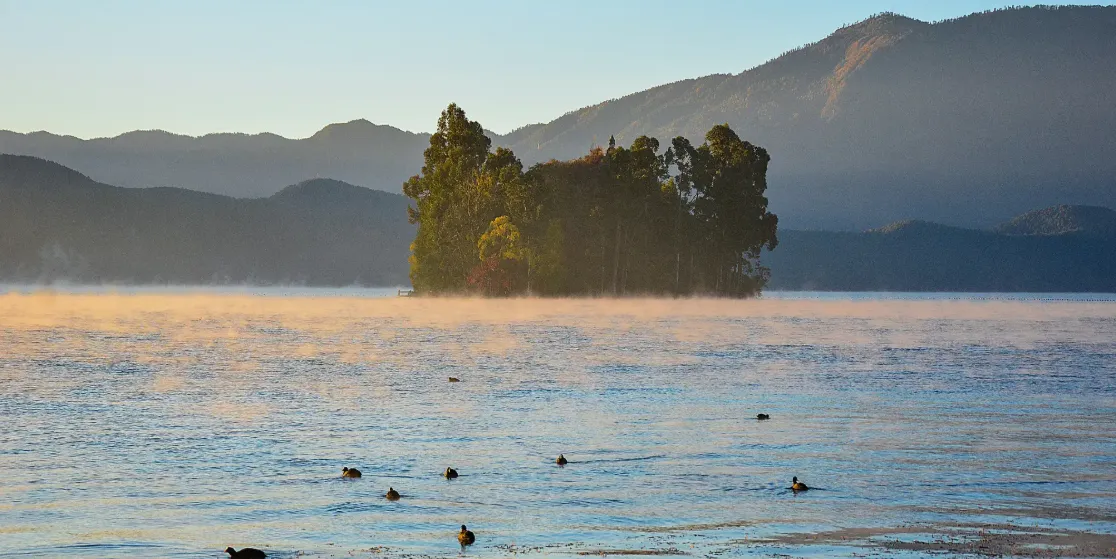
This is Lugu Lake
Lugu Lake lies at the border of Sichuan and Yunnan provinces in China. On the Sichuan side, it belongs to Lugu Lake Town in Yanyuan County, Liangshan Prefecture, with a lake surface elevation of approximately 2,690 meters. In the early morning, mist clings to the lake surface as a narrow, long boat slowly cuts through clear water; in the distance, reed wetlands hide wooden bridges leading to Mosuo villages; further west, Goddess Ge Mu Mountain reflects in the blue waters. Here, there is not only scenery, but also a living tradition—the Mosuo matrilineal family: elder women lead household affairs, inheritance and kinship are traced through the maternal line, some couples practice "walking marriage," without formal weddings, and children live with their mothers.
If you come to China seeking a blend of nature and living culture, Lugu Lake is an ideal choice. The most relaxed highlights on the Sichuan side include four main attractions: the Grass Sea and Walking Marriage Bridge, the pig-trough boats, Goddess Ge Mu Mountain, and sunset views at Goddess Bay; plus a visit to a Mosuo family home to hear firsthand stories about family life, the hearth, and festivals—far more vivid than any signboard.
Five must-see sights on the Sichuan side
Grass Sea and Walking Marriage Bridge
A vast alpine reed wetland, crossed by a 300-meter-long wooden bridge. Green in summer, golden in autumn, and home to water birds in winter. The Walking Marriage Bridge symbolizes Mosuo marital customs, but please approach it with normal perspective: it’s not a curiosity spot, but a gateway to understanding Mosuo family and village relationships. The bridge surface is slippery—please walk along the boardwalk and do not enter the wetland area.
Pig-Trough Boat
A traditional narrow boat used by the Mosuo people, named for its resemblance to a pig trough. On the Sichuan side, departures are available from docks such as Grass Sea and Luo Wa (some docks like Wuzhi Luo may be temporarily closed—check daily notices before departure). In summer, white water hyacinths float on the surface; in winter, red-beaked gulls appear.
Goddess Ge Mu Mountain
Located on the western side of the lake, revered by the Mosuo as a sacred mountain. Take the cable car to enjoy panoramic views of the entire lake and peninsulas. The mountain also features the Goddess Cave and stunning stalactite formations. At elevations above 3,000 meters, mild altitude sickness may occur—walk slowly, avoid running or jumping.
Goddess Bay (Zhaojia Bay)
On the western shore of the Sichuan side, directly facing Goddess Ge Mu Mountain, this is the most stable spot for watching sunsets. On clear evenings, the lake surface reflects golden and orange hues; with low light pollution at night, stargazing is excellent. For sunrise shots, consider Lige Scenic Viewpoint (on the Yunnan side), though a purely Sichuan itinerary doesn’t require crossing provincial borders.
Mosuo Family Visit and Bonfire Night
During the family visit, you’ll see log houses, hearths, handwoven textiles, and taste Su Lima—a low-alcohol millet wine. You’ll also learn the traditional "Jia Cuo Dance" at the bonfire gathering. Please note: do not ask about the child’s father, make jokes about walking marriage, step on the hearth, or take photos of elders or children without permission.
Lugu Lake awaits you, slowly.
Tips
- About "Walking Marriage": It is a form of partner relationship, not synonymous with "free love," nor should it be treated as exotic entertainment; please refrain from prying into personal matters.
- About Matrilineal Families: Elder women typically lead household affairs and children take their mother’s surname—a common tradition, but practices vary among families; always follow the host’s explanation.
- About the Hearth and Prayer Flags: The hearth is the heart of the home—never step on or cross over it. Respect prayer flags and stupas by moving clockwise; do not touch them casually.
- About Photography: Always ask permission before photographing people, especially elders and children. Family visits are paid experiences—follow the host’s guidance when participating.
- About Altitude: With an elevation of 2,690 meters, altitude sickness is unlikely, but avoid running or jumping after ascending. If you feel headache or palpitations, rest immediately, hydrate, and seek oxygen or medical help if necessary.
Scan with your phone to follow.