
Culture, Nature, Cuisine, Life
Mengding Tea
At Mengding Mountain, I tasted a cup of tea dating back to the Western Han Dynasty
Alex ZHANG · Updated at:
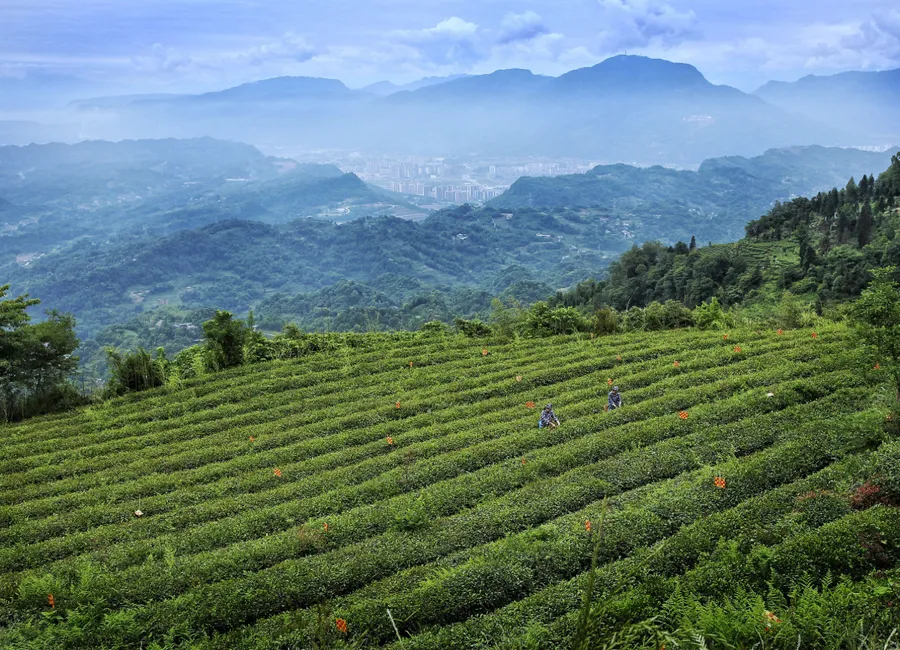
As we drove past Mingshan District, the scenery outside the window suddenly changed — on plains, terraces, and hillsides, rows of tea trees layered one upon another stretching toward the horizon. From high above, they resemble 'fingerprints of the earth,' revealing the secrets of this land. This is the Mengding Tea Region, a mountain 'built up by tea leaves.' After parking, we looked up and saw the giant 'World’s First Teapot' at the entrance of the scenic area, about 10 meters tall, with water flowing continuously from its spout. Some companions rushed excitedly to take photos, while I was stopped in my tracks by the couplet beside it: 'Water from the Heart of the Yangtze River, Tea from the Summit of Mengding' — these fourteen characters tell the story of tea that began in the Western Han Dynasty.
A mountain, half of China’s tea history
Mengding Mountain, also known as Mengshan, is located in Mingshan District, Ya’an City. Named for its 'misty, foggy' weather, it ranks alongside Emei Mountain and Qingcheng Mountain as one of the 'Three Great Historical and Cultural Mountains of Sichuan.' But what truly makes it irreplaceable in China’s cultural landscape are two titles: the birthplace of artificial tea cultivation worldwide, and the starting point of the Sichuan-Tibet Tea-Horse Ancient Road.
The story begins in the Ganlu era of the Western Han Dynasty (53–50 BCE). Yan Dao man Wu Lizhen traveled throughout Mengshan, domesticated wild tea trees, and personally planted seven (some say eight) seedlings at the heart of the five peaks of Mengding, shaped like a lotus blossom. He is recognized as the first person in recorded history to cultivate tea artificially, honored posthumously as the 'Ancestor of Tea Cultivation.' The inscription on the 'Great Mengshan' stele reads: 'The Master surnamed Wu, named Li Zhen... brought the sacred tea seeds and planted them among the five peaks. Standing less than a foot tall, neither growing nor dying, utterly extraordinary.'
This site where the seven tea trees grew became the later Imperial Tea Garden — the earliest known imperial tribute tea production area in Chinese history.
During the Tang Dynasty (742 CE), Mengding tea was officially designated as tribute tea, a tradition that continued uninterrupted for over a millennium until 1911. Historical records state: 'Mengshan lies ten miles south of the county, and every year, tribute tea is sent — the finest in all of Sichuan.' Another ancient text even ranked 'Mengding Shihua' as the top tribute tea nationwide. By the Song Dynasty, Mengding tea had become a strategic commodity used in horse trade — in 1108 CE, the imperial court issued a decree specifying that only tea from Mingshan could be used to exchange for horses, not allowed for any other purpose. A single leaf thus became intertwined with national defense, border trade, and ethnic integration.
Ascending the Mountain: Two Experiences — Cable Car and Heavenly Steps
We chose the classic route: cable car up, Heavenly Steps trail down — saving energy while reserving the full experience of the ancient path for descent.
The cable car ascends slowly, offering views of layered tea terraces below. In March, Mengding Mountain’s tea trees have just sprouted new buds — delicate yellow tips scattered across deep green foliage. Mist rises from the valley floor, resembling boiling cream. After about 10 minutes, we reached the summit.
Tian'gai Temple
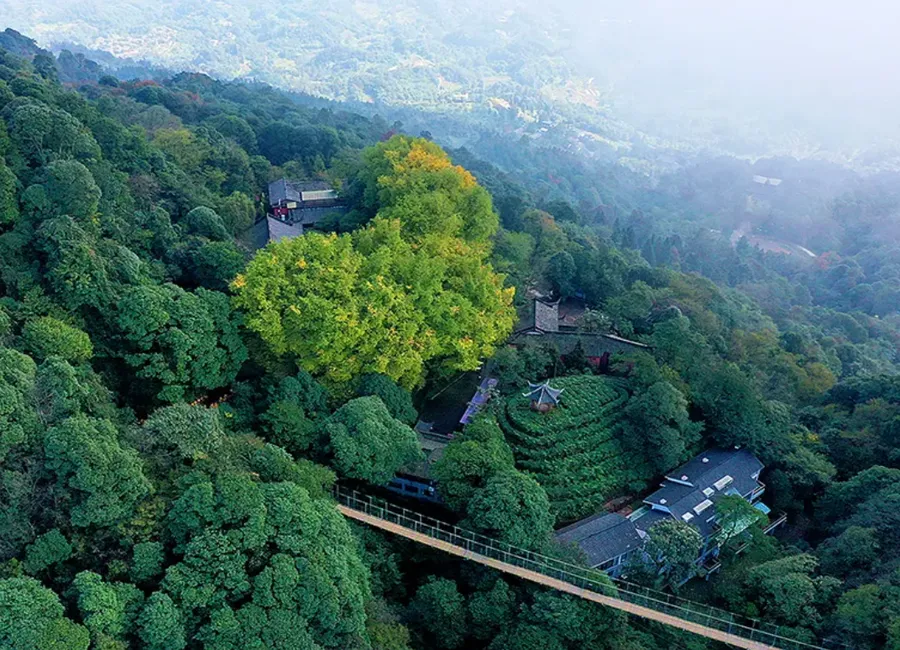
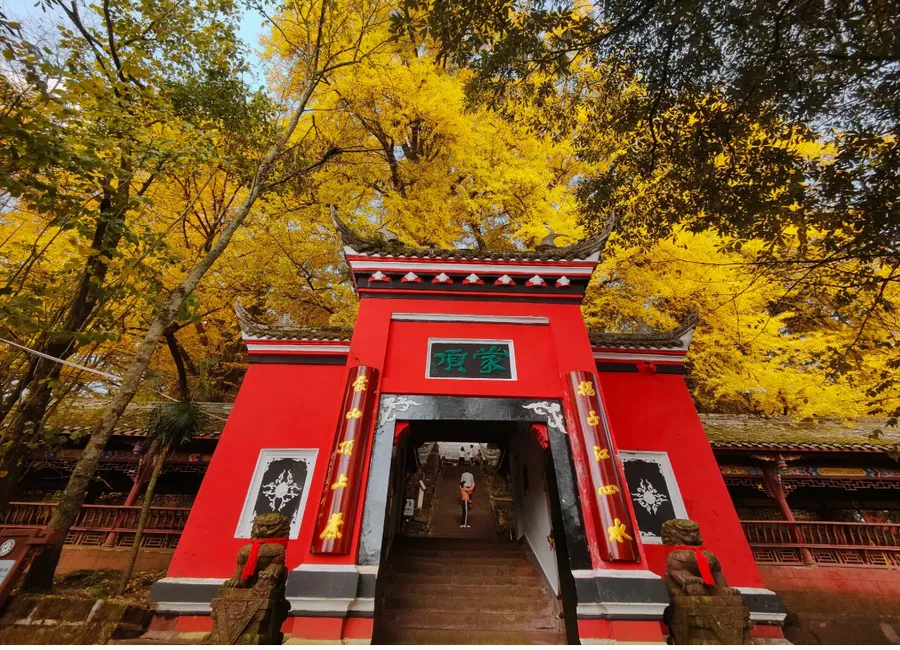
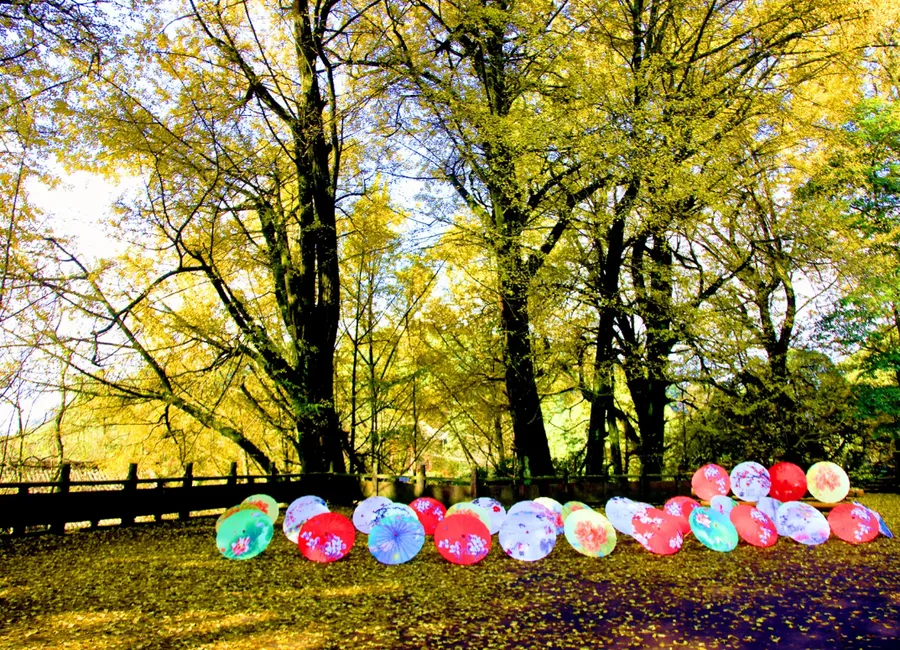
Tian'gai Temple is the first highlight. This ancient timber-framed temple, built during the Han Dynasty and facing south, features a stele titled 'Great Mengshan' rebuilt in the 7th year of Emperor Yongzheng’s reign. Inside the temple, the Tea Ancestor Hall enshrines a statue of Wu Lizhen. Outside, twelve ancient ginkgo trees — each over 2,000 years old — are known as the 'Twelve Beauties of Mengding,' forming one of China’s oldest known groups of artificially cultivated ancient ginkgos.
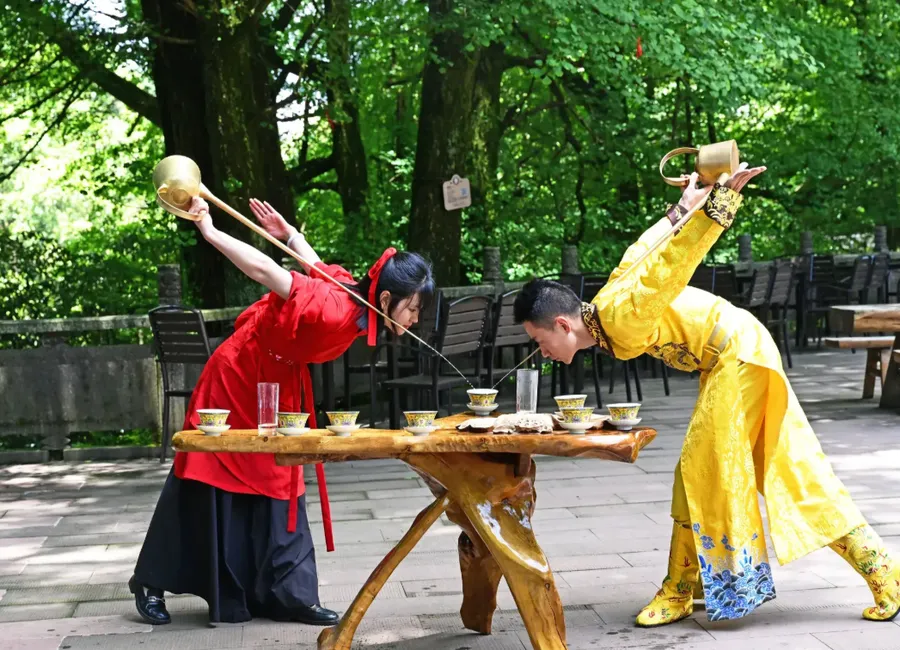
We settled at a teahouse in Tiange Temple and ordered a serving of Mengding Huangya tea for 30 yuan. Pouring boiling water over it, the tea buds stood upright one by one, and the infusion turned bright golden and translucent. At that very moment, we happened to witness the 'Dragon Dance Eighteen Moves' tea performance—long-spouted copper kettles danced in the hands of the tea master, with water flowing like a ribbon, precisely pouring into each cup, drawing gasps from the onlookers. This technique is a living testament to Mengding Mountain’s tea culture (Mengding Mountain is also the birthplace of Chinese gongfu tea).
Imperial Tea Garden
Continuing upward brings us to the Imperial Tea Garden. The red mountain gate bears an immortal tea couplet, with the horizontal plaque inscribed with the words 'Imperial Tea Garden.' Within the garden, stone railings enclose seven ancient tea trees standing quietly in the lotus heart. In his work *On Mengding Tea*, Qing Dynasty magistrate Zhao Yi recorded: 'Each year, only 335 leaves are harvested for tribute; used by the emperor during sacrificial rites to heaven and ancestral temples'—only 335 leaves collected annually for imperial rituals, revealing just how precious this tea truly was.
Ganlu Lingquan Temple
To the east of the Imperial Tea Garden lies the archway of Ganlu Lingquan Temple and the Ganlu Well—legend says this was where Wu Lizhen planted tea and drew water. A stele marked 'Ancient Mengquan' still stands beside the well, and local folk wisdom claims: 'The well never overflows during storms, nor dries up in drought; brewing tea with its water produces an extraordinary fragrance.'
Tian Ti Ancient Path: Walking on the Tea-Horse Road
Descending from the Imperial Tea Garden leads to the Tian Ti Ancient Path—a stretch of 850 meters long, about 1.5 meters wide, built along the mountain slope with a steep gradient of 70° and 1,456 steps carved from green stone.
This path serves as tangible proof that Mengding Mountain was the starting point of the Sichuan-Tibet Tea-Horse Road.
We slowed our pace, running our fingers across the stone steps. From step 433 to step 560, these were original stones, worn deeply by thousands of years of footsteps, their surfaces smoothed and rounded—imprints left behind by officials, monks, and porters who once came here to harvest and transport tea.
What exactly is a 'porter'? They were a special group along the Sichuan-Tibet Tea-Horse Road. Since the Song Dynasty, when 'exchanging tea for horses' became national policy, Mingshan tea was carried forward by footmen and pack mules, crossing sheer cliffs and treacherous mountains to reach the snowy highlands. The Tian Ti Ancient Path preserved today on Mengding Mountain is merely the initial segment of this vast 10,000-kilometer tea-horse route.
On both sides of the path, tall cedars rise skyward, their branches interweaving overhead. Underneath them, tea trees bloom tiny white flowers. Midway along the trail, we encounter the Yuwang Palace—rebuilt in the first year of Tongzhi's reign during the Qing Dynasty. Four massive nanmu pillars, each about one meter in diameter, support the temple roof, and clear ink inscriptions remain visible on the beams.
I recalled a unique cultural phenomenon of Mengding Mountain: five temples with specialized roles—Qianfo Temple managed tea planting, Jingju Temple oversaw tea picking, Zhiju Temple handled tea processing, Yongxing Temple supplied tea, and Tiange Temple was responsible for tea evaluation. This meticulous division of labor ensured the quality of tribute tea and deeply integrated Zen meditation with tea practice, forming the distinctive culture of 'Zen and tea as one.' During the Southern Liang Dynasty, monks already cultivated tea on Mengshan; by the Tang Dynasty, out of 72 monasteries in Mengshan, 36 stood atop Mengding Mountain. One mountain, half of China’s tea history—truly deserving of its name.
Tea Picking Diary: Becoming a Day-long Tea Farmer
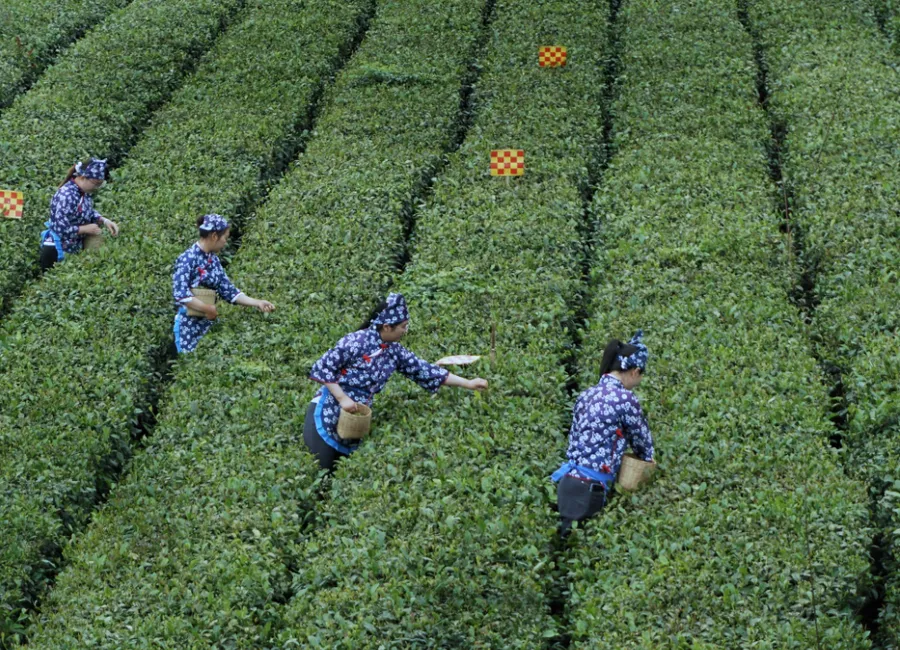
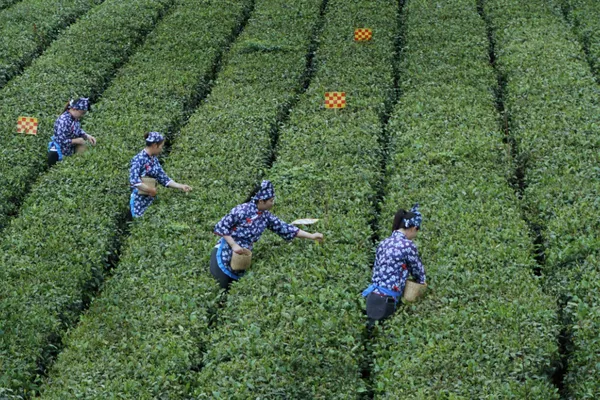
Descending halfway down the mountain, we headed to experience tea picking and processing. The scenic area offers a tea-picking experience for 20 yuan per person, plus an additional 30 yuan for a bowl of covered-dish tea.
Our tea master taught me the standard for 'one bud, one leaf': 'Use your fingertips to pinch, not your fingernails—otherwise the stems will turn black.' I bent low among the tea bushes, morning mist still lingering, dew clinging to the tender buds. After half an hour, my palms held only a small handful—suddenly I understood the rarity Zhao Yi described in '335 leaves harvested annually for tribute.'
The freshly picked leaves were taken to the pan-frying workshop. Traditional Mengding Ganlu processing requires 'three stir-fries and three kneadings,' all controlled by hand to regulate temperature. I tried my hand at stir-frying—the wok was scorching hot, making me instinctively pull back. But the master smiled: 'If it burns, you're doing it right.' It was precisely through these hands’ mastery of heat that the Ganlu achieved its curled shape and distinctive chestnut aroma.
After two hours, I descended the mountain holding a small paper packet of tea I had picked and processed myself—still warm from my palm.
Tea History Museum: Drinking a Thousand Years
At the foot of the mountain, the Mengding Mountain Tea History Museum is open free of charge—an essential conclusion to this journey. Inside, exhibits include thousand-year-old tea bricks, horse caravan leather gear, porter bamboo baskets, and various tea utensils. Here, I suddenly grasped it: from the seven tea trees planted in the Western Han Dynasty by Wu Lizhen, to the 'Mengding Stone Flower' of the Tang Dynasty, to the grand caravans exchanging tea for horses in the Song Dynasty, and finally to silver bottles and tin containers found in the Qing imperial palace—Mengding Mountain tea has witnessed every stage of the development, growth, and maturity of Chinese tea culture. It is unquestionably China’s living fossil of tea.
Here, it nurtured a vital part of the Chinese way of life.
As we descended the mountain, I looked back. Mist rose again, and Mengding Mountain’s five peaks gradually vanished into the white haze of rain.
Suddenly I understood why ancient people paired 'water from the heart of the Yangtze River' with 'tea from the summit of Mengding Mountain'—river water and mountain tea, soft and hard, flowing and still, reflecting the Chinese attitude toward nature: drawing spiritual essence from mountains and rivers, using plants as intermediaries, finding peace and balance within a single cup of tea.
But what makes Mengding Mountain even more special is that it preserves all of this exactly where it began: Wu Lizhen’s seven original tea trees still grow in the lotus heart, the stone steps of the Tian Ti Ancient Path still bear the footprints of porters, and the ginkgo trees at Tiange Temple continue to turn golden year after year. It has not become a specimen in a museum—it remains a living, breathing sacred mountain of tea culture.
If you can visit only once, reserve March for Mengding Mountain—on a crisp morning when spring tea first blooms, walk the Tian Ti Ancient Path, pluck one bud and one leaf with your own hands, then watch the tea master pour you a cup of Mengding Ganlu using a long-spouted copper kettle. In that moment, what you drink is not merely tea—but the rain of the Western Han, the dew of the Tang, the jingle of Song Dynasty horse caravans, and a thousand years of unbroken Chinese tea tradition.
Final Notes — Practical Information
How to enjoy a day trip
8:00 Depart from Chengdu, take the Chengdu-Ya'an Expressway → Mingshan Exit, approximately 1.5 hours 9:30 Arrive at the scenic area, take a photo at the "World's Largest Teapot" landmark 10:00 Take the one-way cable car up the mountain 10:30–12:00 Visit Tian'gai Temple for tea tasting, watch the "Eighteen Styles of Dragon Movement," explore the Imperial Tea Garden and Ganlu Well 12:00–14:00 Tea-picking and tea-making experience + lunch (vegetarian meal at Tian'gai Temple or tea cuisine) 14:00–16:00 Descend along the Ancient Tian'Ti Path, walk all 1,456 steps, visit Yuwang Palace and Jingju An Stone Archway en route 16:00–17:00 Visit the Mengding Mountain Tea History Museum 17:30 Return to Chengdu
How to Explore Deeply Over Two Days
Day 1: Afternoon arrival, stay at a tea farm guesthouse on the mountain slope (tea fields visible from the window). Evening hike to the Heavenly Staircase for views of the sea of clouds. Day 2: Early morning hike along the ancient Heavenly Staircase trail to witness sunrise and sea of clouds. Morning tea picking and processing. Afternoon shopping for tea gifts in the Tea Horse Ancient Town. Departure back to Chengdu at 5:30 PM.
🧭 How to Get Here from Chengdu
- Drive from Chengdu via Cheng-Ya Expressway, arriving at Mingshan Exit in about 1.5 hours
- Take a high-speed train from Chengdu West Station to Ya’an Station (approx. 1 hour), then take a taxi for 25 minutes to reach the mountain gate
🎫 Opening Hours & Tickets
- 8:30–17:30 (daytime session)
- Admission: 52 RMB (peak season), 45 RMB (off-season)
- Cable car: 20–30 RMB (one way)
🍂 Best Time to Visit
- March–April: Spring tea season — pick Mingqian Ganlu and Shihua; the tender tea buds are at their most beautiful
- June–August: Natural cool retreat at 23°C, frequent mist and fog
- Late October–November: The thousand-year-old ginkgo trees at Tian'gai Temple turn golden yellow — a paradise for nature photographers
⛰️ What to Bring When Climbing
- Stone steps are always damp — wear non-slip shoes
- Summit is 5–8°C cooler than base — pack windproof and warm outerwear
- Ya’an is known as the 'Heavenly Leak' with frequent rain — carry an umbrella
Recommended activities
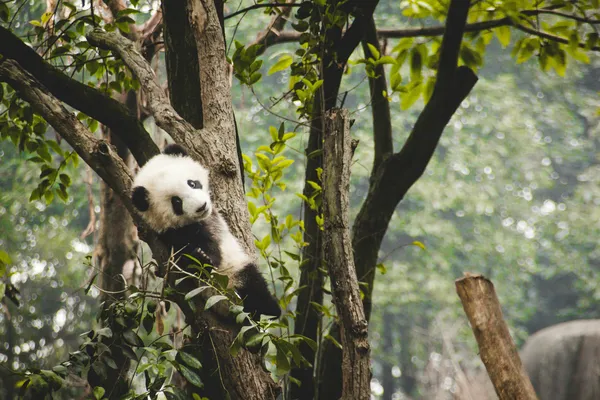
Deep Experience of Giant Panda Base and Local Culture
Visit the world's largest giant panda conservation base and experience daily entertainment life like a local resident.
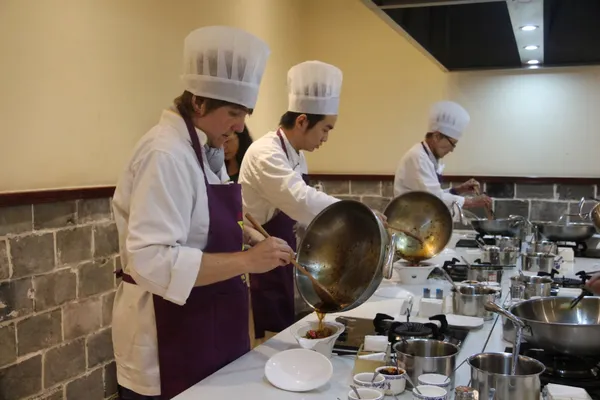
One-Day Sichuan Culinary Cooking Experience
Spend a day experiencing Sichuan cuisine, from traditional neighborhood markets to the Sichuan Cuisine Museum.
Ya'an Mengding Mountain Tea Culture One-Day Tour
Spend a day delving into the world's sacred tea culture mountain, understanding the two-thousand-year history of Sichuan tea, and exploring the ancestral home of the Tea Sage.
Contact us now to plan your private journey
We are available 7 days a week, 24 hours a day to provide you with high-quality, professional service.
Start planning
Scan with your phone to follow.